Prior Art Search – The Key to Success
In a traditional Chinese proverb, there’s a saying. “Know yourself and know your enemy, and you will never be defeated in a hundred battles”. This is a famous quote that is frequently used to describe the importance of having a thorough understanding of your business and what your competitor has to offer. A way to do this, from a patent point of view, is by an analysis called “prior art search”.

The Importance of Prior Art
Whether you’re about to file a patent for a breakthrough idea or preparing to launch a startup with a unique product, conducting a prior art search is a critical step. It’s one of the key factors that could separate you from the 90% of startups that don’t succeed.
But what is a prior art? Generally, prior art is also known as state of the art or background art, depending on the jurisdiction. In majority jurisdiction, prior art is generally defined as anything that is made available, or diclosed, to the public that might be relevant to a patent’s claim before the effective filing date of a patent application for an invention. Though, depending on the countries, the patent systems may define prior art differently. For example, the USPTO’s Manual of Patent Examining Procedure (MPEP) § 901 explains what may constitutes as prior art. Malaysian Patent Act Section 14 explains what the prior art shall consist and the condition to disregard the prior art.
Why Prior Art Search Is Crucial for Your Business
From a business perspective, relevant prior art may indicate that a solution to the problem already exists, making prior art a double-edged sword. On one hand, early awareness of competitors’ solutions allows companies to refine and differentiate their products. On the other hand, it may reveal that a technology is less exclusive than initially assumed. As a result, companies that invest heavily in R&D increasingly hire engineers with prior art search expertise, or equip their engineering teams with such skills, to ensure that newly developed technologies are not merely experimental variations of existing solutions.

Advantage: A thorough prior art search gives you insight into the competitive landscape, helping you avoid wasted investment.
Disadvantage: Discovering relevant prior art might force you to rethink your entire strategy, which could delay product launch or lead to additional costs.
Ask yourself: “Why should customers choose my product if similar solutions already exist?” This is a question both consumers and patent examiners will ask when evaluating the novelty of your invention. If you would like to find out more about why intellectual property matters to your business, read also The Benefits of Having IP.
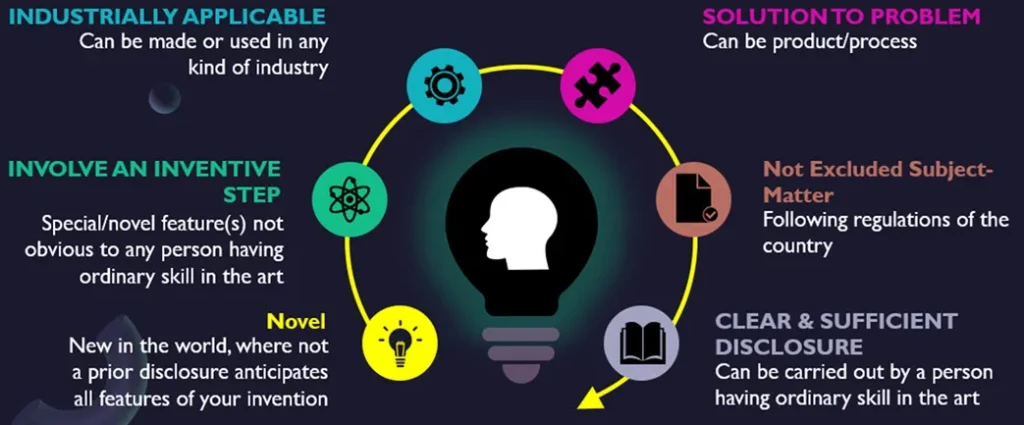
To qualify for a patent, your invention must meet three essential criteria:
Novelty: Your invention must be new and different from prior art. For example, if a prior art has features A, B, C, and D, and your invention has features A, B, C, and E, then your product may be considered novel.
Inventiveness: The invention should not be obvious to someone skilled in the field. If your invention is too simple or an obvious modification of existing technology, it may not be deemed inventive. For example, if you create a self-heating coffee mug by simply adding a heating coil, it may not be considered inventive because similar heating technologies already exist in electric kettles and travel mugs. However, if your mug automatically adjusts the temperature based on the type of beverage inside and uses a novel energy-efficient heating mechanism, it could be considered inventive because it involves a unique technical solution rather than a straightforward improvement.
Industrial Applicability: Your invention must be capable of being made or used in an industry. Hypothetical devices, like time machines, don’t qualify—at least not yet!
If your prior art search shows that your invention fulfils all three criteria, then there is a high chance of getting a patent grant. However, if your invention is novel but not inventive, then you may be able to pursue a Utility Innovation (UI). A UI is a small or petty patent which has a lower patentability requirement. For an invention to be eligible for a UI, the invention only needs to fulfil novelty and industrial applicability requirements. However, note that UI is only available at certain jurisdiction, such as Malaysia, Indonesia, China, the Philippines, and some other countries.
How a Prior Art Search Impacts Your Business Strategy
Performing a prior art search allows you to gauge your competition and ensure your product is truly novel and inventive. If you find relevant prior art, it doesn’t necessarily mean you need to abandon your idea. Instead, you may need to refine or reposition it to stand out.
Advantage: A comprehensive prior art search can reveal market gaps that you can capitalise on.
Disadvantage: It could also show that the market is already saturated, forcing you to reconsider your entry strategy.
Myth: Rejected/Abandoned Application Is Not A Prior Art
Wrong! Let’s revisit the definition of “prior art” – any existing references or documents. For a patent application to be rejected due to a deficiency in patentability, the patent application must have been published. This inherently categorises the published patent application as “existing documents”. Even if your previous patent application has been abandoned due to failure to respond to the examiner’s queries on the patentability of the patent application, your patent application is still considered “published”. Hence, it will be considered as a prior art to your new invention if your new invention is modified or improved according to the rejected/abandoned application. This has been especially highlighted by the USPTO in MPEP § 901 on what constitutes as prior art.
To overcome this issue, you can attempt to withdraw the application within 18 months from the date of filing. Majority countries’ patent offices keep a patent application hidden for 18 months from the date of filing. Withdrawing the patent application from the registrar within that timeframe would render the invention unpublished, and hence it would not be considered as prior art, as the patent application is considered a confidential document before it is published.
Conclusion
In summary, conducting a prior art search is essential whether you’re applying for a patent or validating a business idea. It helps you identify competitors, refine your product, and make smart, strategic decisions. Without a prior art search, you risk spending time and money on an invention that could already exist.
By taking the time to analyse the market and relevant prior art, you’ll be in a better position to either secure a patent or pivot your business toward a more promising opportunity.
Don’t skip this crucial step—your success could depend on it!

Dr. Shakir Yusop
Patent Executive [email protected]

Dr. Marcus Chee
Patent Manager [email protected]

Dr. Tan Jian Hong
Senior Patent Executive [email protected]